
Dane County Criminal Court Cases
The Dane County Circuit Court hears Wisconsin felonies, misdemeanors, and criminal traffic matters. Its cases commonly carry CF, CM, or CT identifiers. CF marks a felony file, CM a misdemeanor file, and CT a criminal traffic file. Those labels describe the court case type, not the final result. The Clerk of Circuit Court keeps the official Dane County criminal court record, including pleadings and judgments that do not reliably appear as downloadable documents in the online index.
Municipal courts sit on a different track. Madison, Sun Prairie, and Fitchburg municipal courts decide ordinance forfeitures, including many traffic matters and some first-offense OWI cases. Their files do not belong to the Dane County Record Center. A citation may thus create a municipal record without a Circuit Court criminal case. Start by asking whether a state criminal charge was filed, rather than assuming every local citation belongs in WCCA.
Searching Dane CF, CM, CT Cases
Dane County criminal court cases use a filing year, a case-type code, and a sequence number. The three criminal codes help narrow a name search and make a known case number the fastest route. They also prevent a common mistake: reading the seriousness of the initial charge as the outcome. A CF file may contain reduced or dismissed counts, while a CM or CT file can contain several separate counts with different results.
- CF
- A felony case filed in Wisconsin Circuit Court.
- CM
- A misdemeanor case filed under state criminal law.
- CT
- A criminal traffic case, distinct from a routine civil traffic citation.
- Disposition
- The result recorded for a count or the case.
Rule 205 adds another Dane County wrinkle. When one defendant has pending CF, CM, or CT matters, the court may coordinate the related cases. Search each number and compare the branch, event history, and scheduled hearings. A coordinated file does not merge every charge into one docket.
Searching Dane County Case Records
Wisconsin Circuit Court Access, often called WCCA or CCAP, is the first public search channel for Dane County criminal case records. Dane's criminal index reaches approximately back to 1984. WCCA is free, but users must accept its agreement before searching. The interface confirms party-name and case-number routes, a county filter, and a search action. Some JavaScript-driven options were not exposed in the source review, so no unverified wildcard or hidden dropdown behavior should be assumed.
- Open WCCA, accept the terms, and choose the party-name or case-number route.
- Select Dane County and enter the best-known spelling or the complete case number.
- Use date of birth when it is displayed, plus filing period and case type, to separate similar names.
- Open the docket and review charges, pleas, event entries, disposition, sentence, and financial judgment.
- Ask the Dane Record Center for the exact filed document or a certified copy when the docket summary is not enough.
The official WCCA search screen is shown below as the source interface for a Dane County criminal case search.
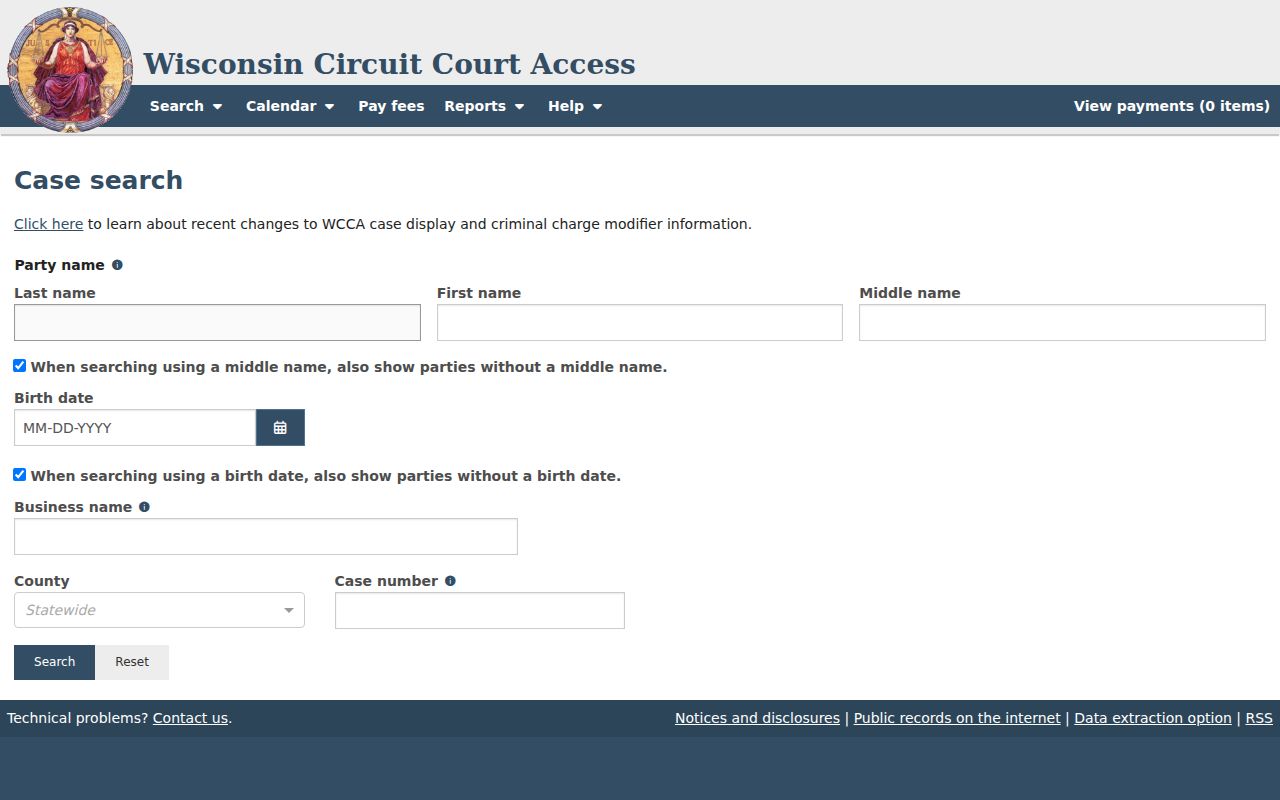
The screen leads to a docket index. It does not replace a filed complaint, judgment, or certified copy from the Dane County clerk.
| Confirmed control | Type | Required | Use |
|---|---|---|---|
| Agreement gate | Acceptance | Yes | Opens public search access |
| Party/name route | Text search | For name route | Finds possible party matches |
| Case-number route | Text search | For number route | Finds a known docket directly |
| County | Filter | No | Select Dane to narrow results |
| Date of birth | Identity aid | No | Helps distinguish criminal subjects when shown |
Dane Criminal Court Record Center Fees
WCCA identifies a file, while the Dane County Record Center supplies open pleadings, certified judgments, and older court records. The center is in Room 1002 of the Dane County Courthouse. Requests may be made in person, by mail, fax, or email. The office does not accept a records request by phone, though staff answer questions at (608) 266-4311. Email requests go to dane.courtrecords@wicourts.gov.
Give the clerk every known name spelling or alias, approximate filing year, date of birth if known, case number, exact document title, delivery method, and whether certification is needed. Inspection of an open file is free. A name search without a case number costs $5 per name. Copies cost $1.25 per page, certification costs $5 per document, and exemplification costs $15 plus copying. Postage is charged at actual cost, and prepayment may apply when charges exceed $5. Dane County states a usual response range of one to ten business days, subject to retrieval or review needs.
Dane County Record Center
215 S. Hamilton St., Room 1002
Madison, WI 53703
(608) 266-4311
Weekdays, 7:45 a.m. to 4:30 p.m.
Inside a Dane County Case File
A Dane County criminal case file records what prosecutors filed and what the court did with each count. WCCA can show the caption, case number, filing date, status, branch, district attorney number, parties, counsel, charges, statute, severity, offense date, plea, disposition, events, sentence, and financial balance. The clerk's file supplies the actual pleadings and orders. Read count-level results because one count can be dismissed while another ends in conviction.
| Case number and branch | Identifies the Dane docket, filing year, case type, sequence, and assigned court. |
|---|---|
| Charging document | The complaint or information states the prosecutor's filed allegations and counts. |
| Docket events | Lists hearings, motions, filings, pleas, and other court activity by date. |
| Charge detail | Shows statute, severity, offense date, plea, and the result for each count. |
| Judgment and disposition | Records whether a count ended in conviction, dismissal, acquittal, or another result. |
| Sentence and finances | Lists the ordered sentence and available financial judgment entries. |
Protected identifiers do not belong in the public view. Wisconsin Statute §801.19 covers Social Security, financial-account, driver's-license, state-ID, passport, and specified tax or employer identifiers. Victim, witness, and juror information can also be withheld. Absence from the public display does not mean the data never existed in the original filing.
Eight Branches Share Dane Criminal Cases
Dane County uses an equal criminal draw for the August 2025 through July 2027 rotation. Branches 2, 3, 5, 7, 8, 11, 12, and 14 each receive a 12.5 percent share of new criminal filings. All sit at the Dane County Courthouse. The branch assignment tells a reader where the case is managed, but it does not signal the likely disposition. Rule 205 may coordinate a defendant's other pending criminal matters.
The official Dane County case-assignment page is the source for the current rotation. Specialty paths include Drug Court, OWI Treatment Court, and Veterans Treatment Court. Dane's Deferred Prosecution Program is separate from those court programs and can divert eligible referrals before conviction. Its agreements commonly last six to 36 months, with no program fee, though outside treatment or education can cost money. An unsuccessful referral returns to the ordinary prosecution path.
How a Criminal Case Moves
A Dane County prosecution starts when law enforcement refers arrest information and the district attorney decides whether to file. The district attorney reports that a complaint is usually filed within one to four days after receiving arrest information, but the actual time varies. In-custody weekday initial appearances are generally held at 1:30 p.m. in the Public Safety Building. The initial booking allegation can change once the prosecutor files the complaint.
Case flow: Charges Filed › Arraignment › Pretrial › Plea or Trial › Disposition › Sentencing
At arraignment, the defendant enters a plea. Pretrial entries can reflect motion practice, discovery, scheduling, negotiations, or specialty-court screening. A plea or trial leads to a result for each count. Sentencing follows a conviction, while an appeal can create a later court record. The docket should be read by date, and the most recent event should be checked before relying on an earlier status.
Reading Dane Criminal Case Outcomes
Disposition language deserves close reading. “Dismissed” means the charge ended without conviction. “Dismissed/read in” also is not a conviction on that count, although the court may consider it for sentencing or restitution in another count. An acquittal is a not-guilty finding after trial. A guilty or no-contest plea produces a conviction, as does a guilty verdict. The sentence is the court-ordered result after conviction, not another word for the conviction itself.
WCCA is indexed by name and is not fingerprint identity proof. Compare Dane County, the filing period, case number, and date of birth when displayed. Similar names can point to different people, while the public display intentionally omits some identifiers. For the reader's own statewide fingerprint-supported history, the Wisconsin DOJ Crime Information Bureau process is the stronger identity channel. For an exact Dane County judgment, a certified clerk copy is stronger than a screen capture.
Note: A docket match is a lead to the court file, so confirm identity and the count-level outcome before drawing conclusions.
Dane Criminal Court Archives
The Dane County clerk keeps roughly five years of files onsite. Many records from 1992 through 2002 are stored offsite and can take several days to retrieve. Many pre-1992 files survive on microfilm. Simple traffic and noncriminal ordinance records may remain onsite for only one year. These storage rules explain why a valid old case may require more than a quick WCCA search.
The Dane County courthouse photo and history collection provides the source image below.
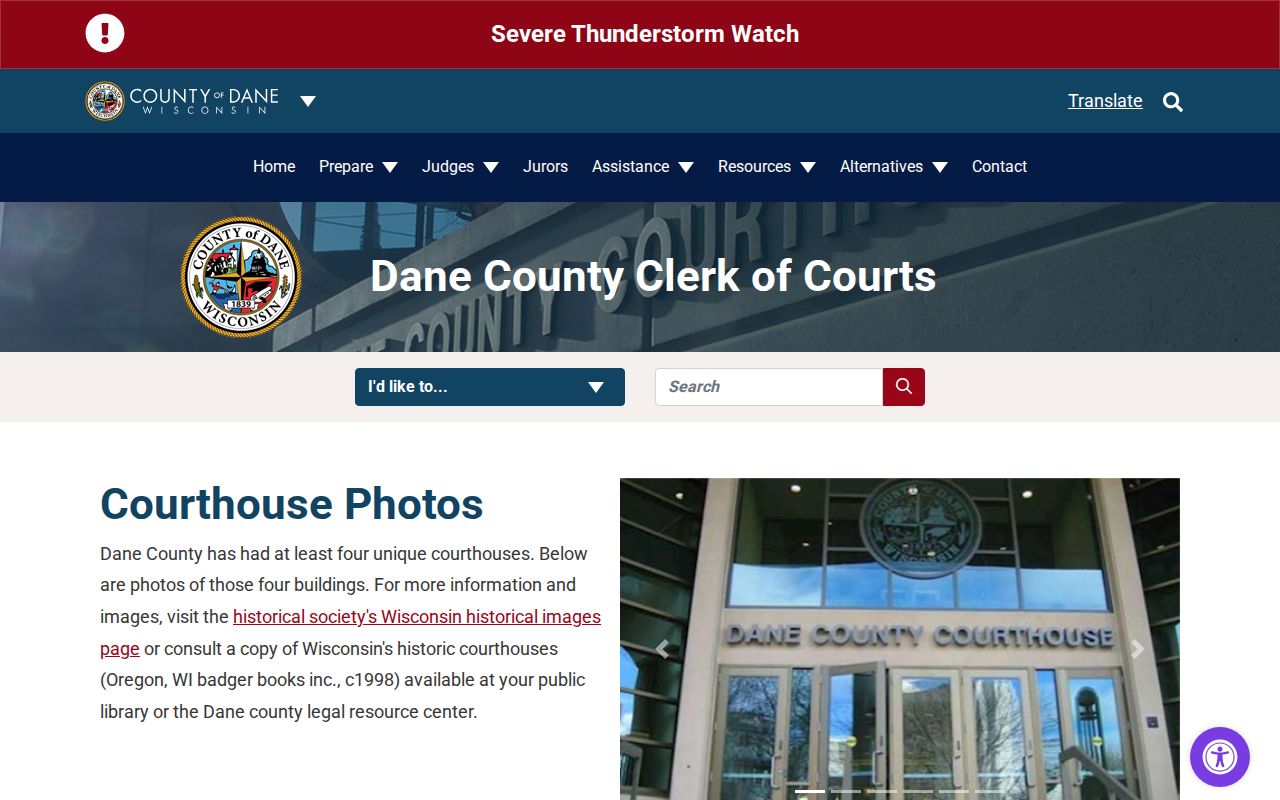
The courthouse is the present home of the clerk and Record Center, while older files may still require offsite or microfilm retrieval.
If the online search fails, send a focused request rather than asking for every record about a person. Include aliases, an approximate year, case type, date of birth if known, and the precise filing needed. Judicial review of confidential material can extend the response time. The Record Center holds Dane Circuit Court files only, not municipal cases or records from another Wisconsin county.
Case Record Access & Restrictions
Wisconsin Public Records Law favors access, but court records remain subject to statutes, court orders, and privacy rules. Wisconsin Statute §801.19 protects specified personal identifiers. Section 801.21 supplies a motion and order process to protect a court record. Juvenile matters, protected victim or witness information, juror data, and sealed material are not available through ordinary public searching.
Expungement under Wisconsin Statute §973.015 is narrow and generally must be ordered at sentencing, followed by successful completion. It concerns the qualifying court record and does not by itself erase every police or repository record. When a Dane County criminal court case is absent, ask the clerk whether the issue is archive coverage, municipal jurisdiction, restricted access, or a search mismatch. Staff can explain access procedure, but the clerk cannot provide legal advice.