
Checking Criminal History in Dane County
Choose the source by record type. Wisconsin Circuit Court Access, often called WCCA or CCAP, is the first stop for a filed Dane County criminal case. The Dane County Sheriff's Office resident roster answers whether a person is currently in the county jail. The arresting police agency holds its own incident narrative. The Wisconsin Department of Justice Crime Information Bureau supplies the statewide fingerprint-supported product through WORCS. None of those sources replaces the others.
Gather the full name, alternate spellings, an approximate date, and a date of birth when it is lawfully displayed. A case number or agency report number is stronger than a name alone. Then work in this order:
- Search WCCA by party name or case number and limit the county to Dane.
- Compare the county, filing period, date of birth when shown, and case number before accepting a match.
- Read the charges, court events, disposition, sentence, and financial entries.
- Use the current jail roster or the arresting agency's report channel when custody or police narrative matters.
- Ask the Dane County Record Center for the filed or certified document when the docket summary is not enough.
Dane Criminal Records on Hamilton and Doty
Dane County records are split across adjacent downtown buildings. The Clerk of Circuit Court and Record Center sit at 215 South Hamilton Street. They maintain circuit filings, judgments, and archived case material. The Sheriff's Records Section and Central Booking are next door at 115 West Doty Street. That office handles Sheriff-created incident, booking, jail, warrant, audio, photo, and video material. A request sent to the wrong counter can lose time because neither office is a general clearinghouse.
The official Dane County homepage shows the broader department structure. This government image provides useful context for the county offices discussed here.
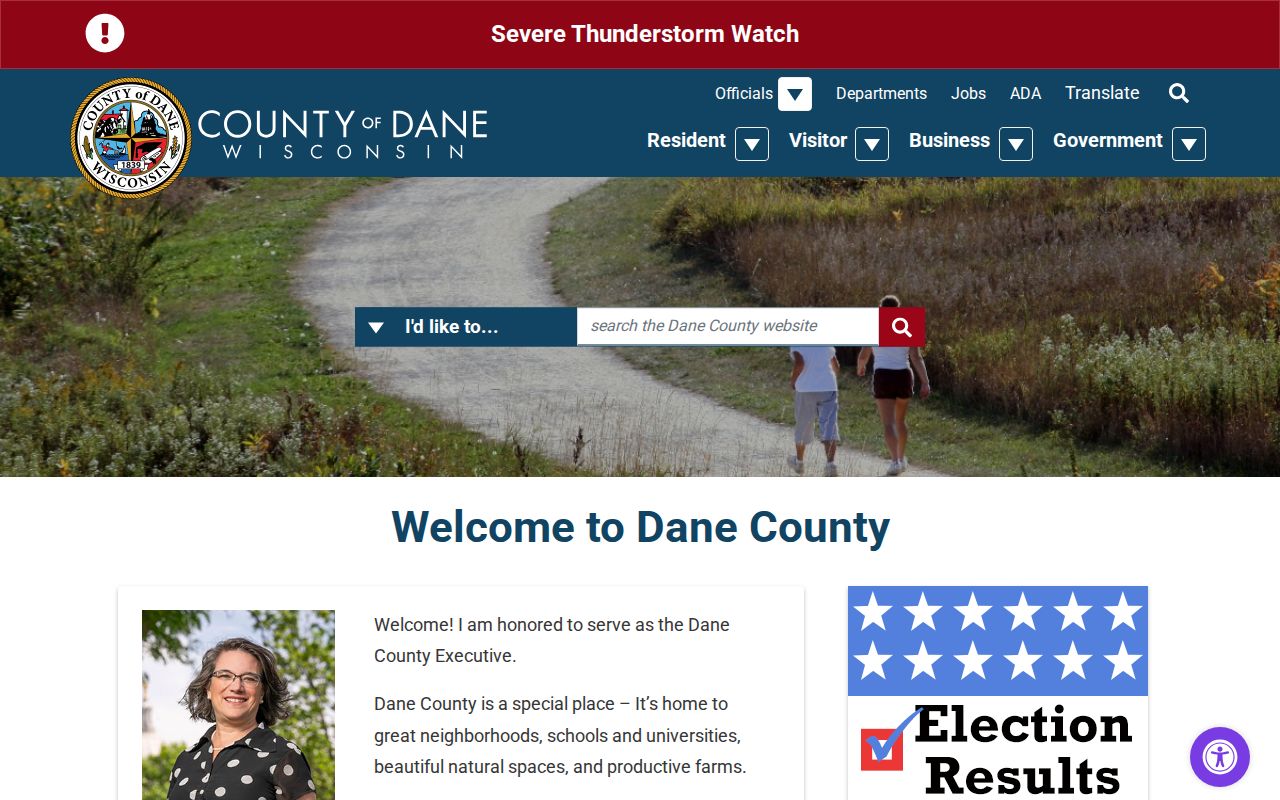
The county directory reinforces a key rule: request the record from the department that created or keeps it.
Dane County Record Center
215 S. Hamilton St., Room 1002
Madison, WI 53703
(608) 266-4311
Weekdays, 7:45 a.m. to 4:30 p.m.
DCSO Records Section
115 W. Doty St., second-floor lobby
Madison, WI 53703
(608) 284-6827
Weekdays, 8 a.m. to 4 p.m.
Wisconsin Official Background Checks
The Wisconsin Department of Justice, Division of Law Enforcement Services, Crime Information Bureau maintains the Centralized Criminal History repository. Any person may order a public adult name check through the Wisconsin Online Record Check System. The result is drawn from fingerprint-supported Wisconsin reporting. It can include demographics, arrests, charges, final dispositions, sentences, DNA registration data, and Department of Corrections admission or release entries.
Public users may submit anonymously, but they must save the order reference number shown on the receipt to retrieve the result. Results remain available for six months. A missing result does not prove that no booking or court case exists. An arrest without supporting fingerprints or a delayed disposition may be absent.
The official WORCS screen shows where Wisconsin criminal-history requests begin.
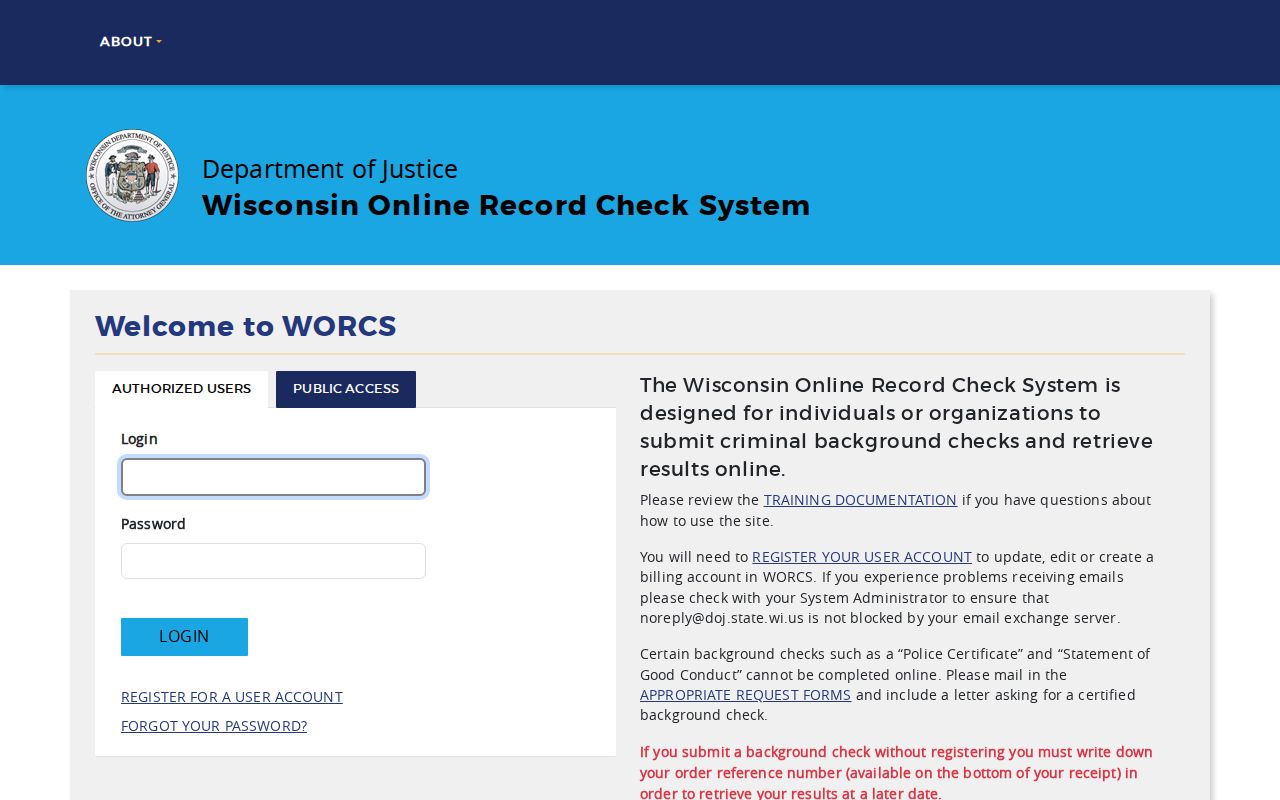
Use WCCA and the originating office to fill gaps when a repository response does not resolve the question.
Dane Criminal Record Search Fees
Fees depend on the custodian and product. Inspection of an open Dane court file is free. The Record Center charges for staff name searches and copies. DOJ applies a separate statutory fee to repository checks. DCSO accepts a request without advance payment, then may invoice when production or media work crosses its threshold.
| Product | Cost | Important limit |
|---|---|---|
| WORCS online name check | $7 | Wisconsin public adult history |
| Mailed general CIB check | $12 | Includes $5 paper surcharge |
| Dane clerk name search | $5 per name | Applies without a case number |
| Court copy | $1.25 per page | Certification costs $5 per document |
| General county copy | 25¢ single-sided | Different schedules govern court and Sheriff work |
Ask for an estimate before ordering a long file or redacted video. DCSO may require prepayment above $5 and publishes a body-camera processing rate of $32.80 per staff hour. Court exemplification costs $15 plus copying, and postage is charged at its actual cost.
Criminal Record Types
A criminal event produces distinct records at distinct times. The police narrative explains the alleged incident. Central Booking logs custody, holds, and identifiers. The District Attorney may file charges that differ from the booking allegations. The circuit clerk then tracks hearings, pleas, decisions, and sentence. CIB receives qualifying fingerprint and disposition reports. DOC separately tracks prison and community supervision.
- Incident report: the creating police or sheriff agency's account and supplements.
- Booking record: current custody intake, arresting agency, offenses, holds, and location.
- Circuit case: filed charges, events, disposition, judgment, sentence, and money entries.
- WORCS history: reported fingerprint-supported Wisconsin arrest and outcome cycles.
- DOC or registry entry: incarceration, supervision, or sex-offender registration data.
Municipal ordinance files form another branch. Madison, Sun Prairie, and Fitchburg municipal courts decide forfeitures, not Wisconsin crimes. A city citation can exist without a Dane County jail booking or WCCA criminal case.
Dane Warrant Records Need Live Confirmation
The Dane County active-warrant page is free and updated daily, but it is not real time. Call the Warrants Division at (608) 284-6110 during business hours for the most current confirmation. Ask which court issued the warrant before appearing or paying. Circuit warrants can leave events in WCCA, while an ordinance bench warrant may belong to a municipal court that the Dane clerk does not maintain.
The official warrant interface illustrates the public starting point.
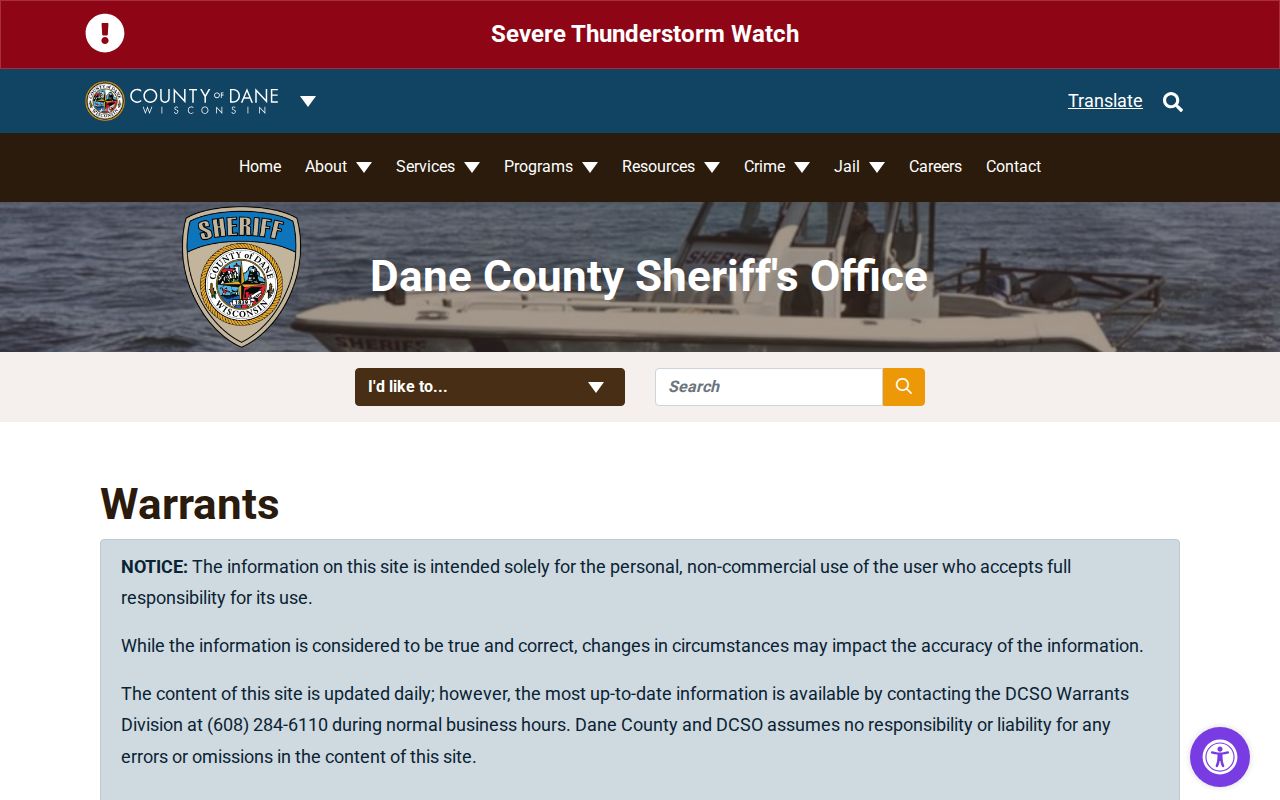
When the list does not settle the issue, use the phone line, a DCSO records request, WCCA, and the issuing court. Wisconsin has no public statewide warrant database.
Inside a Dane County Criminal Record
Read each display for what its custodian actually records. WCCA can show a caption, Dane County case number, filing date, case type, status, branch, DA number, parties, counsel, charges, statute, severity, offense date, plea, disposition, events, sentence, and financial judgment. The public jail detail uses a different field set. WORCS is a repository response, not a copy of every court document.
| Name and identifiers | Party name, date of birth when public, case number, booking number, Name Number, or agency number |
|---|---|
| Arrest and booking | Arrest time and agency, booking time, offense, hold or entry code, custody location, and release data |
| Charges and statutes | Count, offense label, Wisconsin statute, severity, filing date, and offense date |
| Disposition | Plea, dismissal, acquittal, finding, conviction, and date as recorded by the court |
| Sentence | Custody, probation, extended supervision, fines, costs, and restitution entries |
| Restricted data | Protected identifiers, victim or witness information, juvenile material, and sealed content do not appear in ordinary public views |
Dane Jail Roster or DOC Record
The Dane County Sheriff's Office current resident roster covers people now held in its two-facility jail system. It is not a historical arrest search. A detail may list judicial status, building or area, scheduled release, booking and arrest numbers, arresting agency, case number, offenses, court number, and disposition or hold codes. The inspected public view did not show a mugshot, date of birth, physical description, bond, judge, courtroom, or medical flags.
Use the Wisconsin DOC Person in Our Care or Client Search for state prison, probation, parole, or extended-supervision status. County custody and state supervision are different. VINE supplies county custody notices, while DOC NOTIS provides enrolled victims with custody, supervision, and registry updates. An old roster entry should never be treated as proof of a current conviction or location.
Judicial-status labels also need care. Dane County uses terms for prearraignment, county pretrial, probation or parole holds, sentenced custody, work release, presentence investigation, outside holds, state transit, and electronic sanctions. A status describes why the jail is holding someone at that moment. It does not replace the court's finding or sentence. When the person has left the public roster, request historical booking material from DCSO Records and use the booking number, Name Number, arresting agency, and agency case number to narrow the request.
Public Access Laws in Wisconsin
The Wisconsin Public Records Law favors inspection and copying, subject to specific statutes and the common-law balancing test. A focused Dane County request should identify an existing report, case, date range, location, named subject, and record type. The county need not create a new list. Active investigations, juvenile material, victim data, protected identifiers, and sealed matters can be withheld or redacted.
Key Wisconsin laws:
Wis. Stat. §19.35 sets the basic right to inspect and copy authority-held records.
Wis. Stat. §165.83 defines CIB repository duties and criminal-history functions.
Wis. Stat. §165.84 governs fingerprint and arrest-data reporting.
Wis. Stat. §801.19 protects specified personal identifiers in court filings.
Wis. Stat. §973.015 controls Wisconsin expungement eligibility and effect.
Correcting a Dane Criminal Record Match
First identify the source of the error. A WCCA same-name match may concern someone else, so compare Dane County, the filing period, case number, and date of birth when displayed. Ask the Record Center for the actual judgment or charging document when a screen summary is unclear. If the statewide CIB history wrongly connects another person's record to you, use the DOJ identity-challenge process with an FD-258 fingerprint card taken by a law-enforcement agency and form DJ-LE-247.
The Wisconsin DOJ challenge page describes the official correction route.
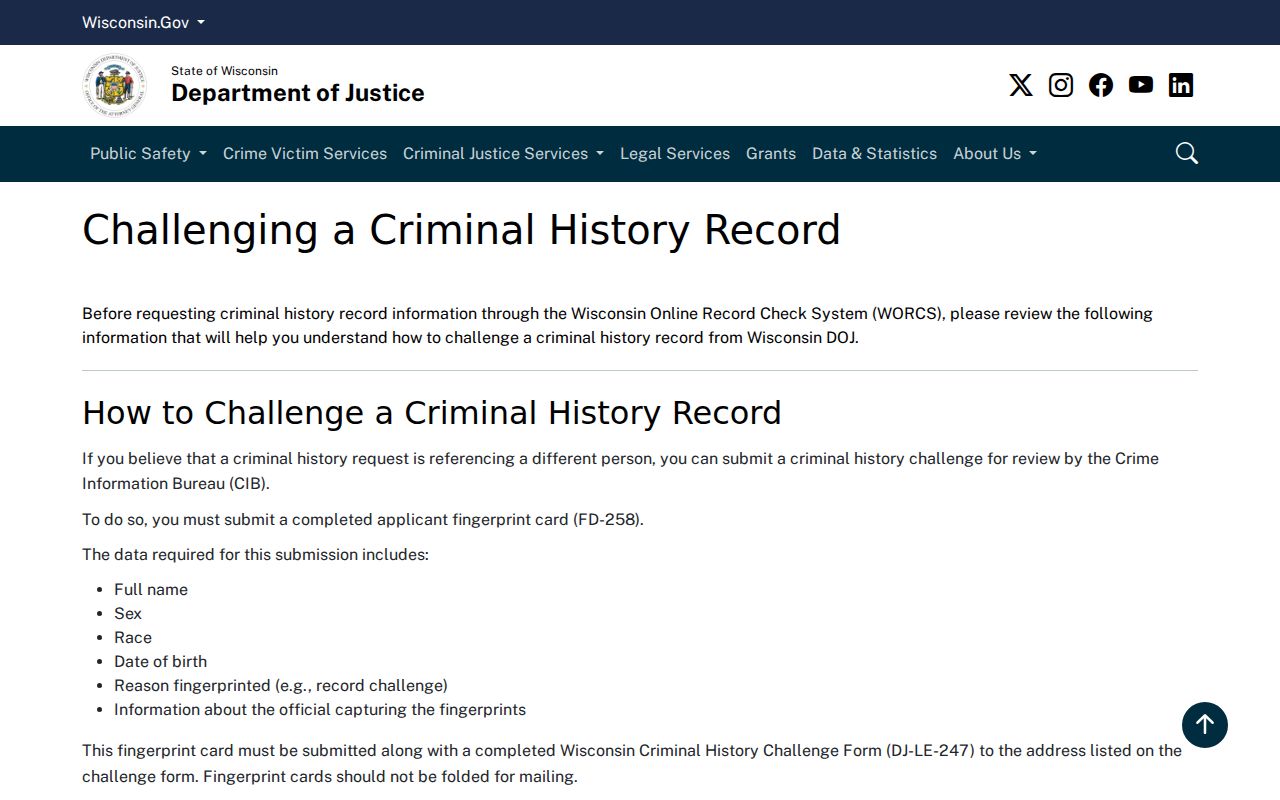
A successful mistaken-identity challenge can produce a WiUPIN for later searches. Incorrect conviction data should be supported with a certified court judgment or order.
Sealed, Expunged, and Restricted Records
Wisconsin expungement under §973.015 is narrow. Eligibility commonly requires that the offense occurred before age 25, stayed within the statute's severity limit, avoided listed exclusions, and had expungement ordered at sentencing. Successful sentence completion is also required. Wisconsin generally does not offer a broad later petition for an otherwise eligible adult who did not receive the order at sentencing.
Relief concerns the circuit-court record. Form CR-266 warns that it does not by itself erase police, CIB, or other law-enforcement records. DOC certification triggers ordered relief after probation or incarceration. Juvenile records, protected victim and witness identities, juror details, and §801.19 identifiers are also restricted through separate rules. A sealed record will not remain available through ordinary public access.
Dane Criminal Records After Diversion
Dane County's Deferred Prosecution Program can divert eligible referrals before conviction. Agreements commonly last six to 36 months. The program charges no program fee, though participants pay outside treatment or education costs. Named tracks include opiate diversion and the Child Abuse Initiative. Successful completion changes the prosecution path, while an unsuccessful referral returns to normal case processing.
The District Attorney's program page is the official source for its current structure.
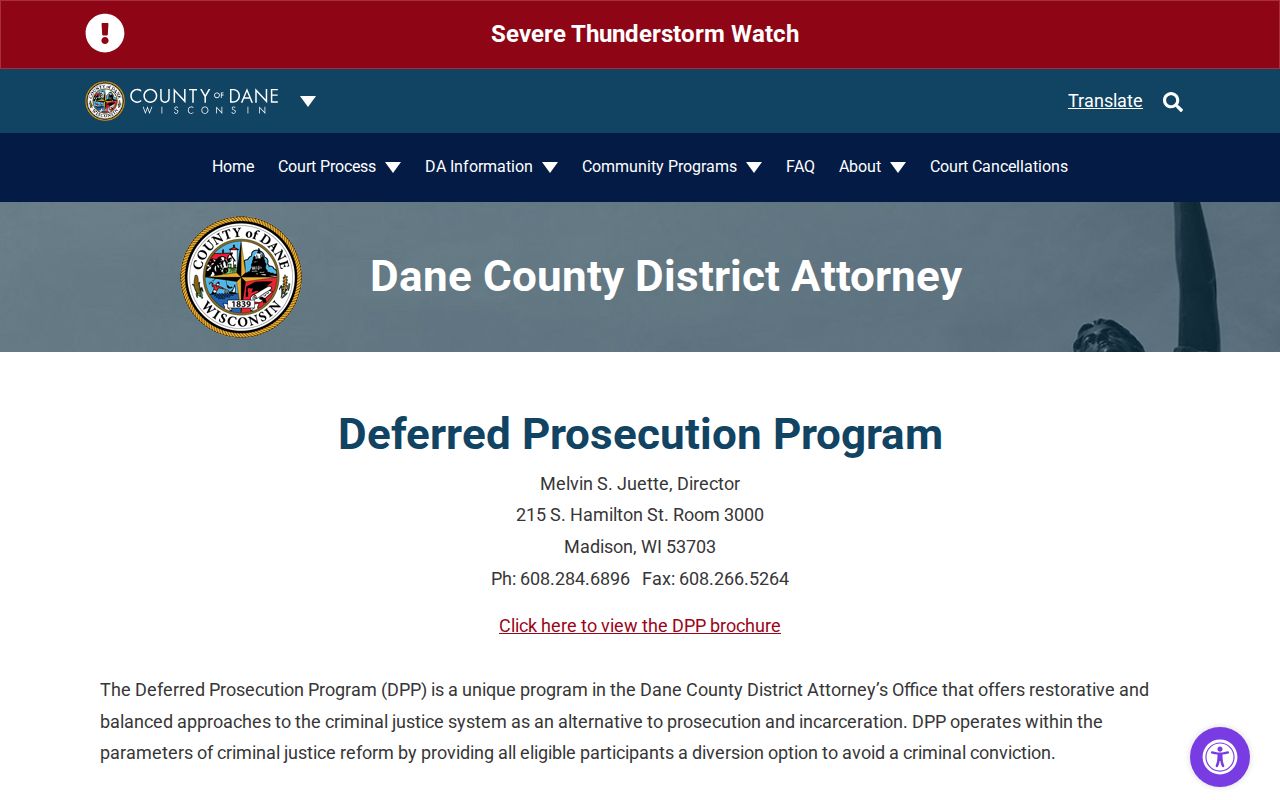
The record trail still depends on how far a referral moved before diversion and what the court or prosecutor filed.
Dane Criminal Reports Stay Agency-Specific
DCSO does not hold every police report in Dane County. Madison, Sun Prairie, Fitchburg, university police, Capitol Police, State Patrol, and other local departments keep the reports they create. Since October 2018, formal MV4000 or DT4000 crash reports have gone to the Wisconsin Department of Transportation, although DCSO can still hold related narratives, photos, citations, or video. Dane County Communications may hold some 911 recordings.
For a Sheriff record, use the DCSO online request form, mail, fax, or the second-floor counter. Requests may be anonymous, but email or postal delivery still needs a destination. DCSO says email delivery is usually fastest and a request may take up to three business weeks. Do not email a formal electronic request to the general records address.
Dane County Criminal Records by City
City police departments create their own incident files, and municipal courts keep ordinance cases outside the Dane County Record Center. The three largest incorporated cities use different portals, fees, counters, and court schedules. Their guides keep city-level requests at the right altitude while routing criminal prosecutions and custodial bookings back to county systems.
Madison Criminal Records
Population 286,233. MPD has a secure request portal, while Municipal Court keeps ordinance files.
Sun Prairie Criminal Records
Population 39,227. Police records use JustFOIA and the West Precinct counter.
Fitchburg Criminal Records
Population 34,615. The Records Bureau accepts online, phone, fax, email, and counter requests.
Dane Criminal Records Across Four Courthouses
Dane County has used at least four courthouse buildings. An older jail joined a sheriff's residence where the sheriff and spouse lived until 1940, and the spouse served as cook and housekeeper. A tunnel under South Carroll Street later linked the City-County Building and Public Safety Building. Today the 2005 courthouse contains 18 courtrooms, ten commissioner rooms, a Record Center, and technology for displaying documents and other evidence.
That history explains the present records map. Court files sit on Hamilton Street. Sheriff records and Central Booking sit on Doty Street. Maximum-security jail housing remains at the City-County Building on Martin Luther King Jr. Boulevard. Consolidation work seeks to replace aging cells and improve medical and mental-health space, so current facility statements should rely on the Sheriff's two-facility listing rather than old three-facility references.
The courthouse layout adds another practical distinction. Public counters and the Record Center occupy the first floor, commissioner rooms are on the second, and most circuit courtrooms are on upper floors. The Law Library in Room L1007 offers public computers, Westlaw, and forms on weekdays. Its copies cost 25 cents per page. Those services can help a reader identify a document, but the Record Center remains the custodian for the case file and its certified copies.